Learn how to build a strong personal brand on social media, attract the right audience, establish credibility, and create new career opportunities.
Table of Contents
In today’s digital world, your social media profile can be more than just a place to share photos, opinions, or updates. It can become your professional identity. Whether you are a student, entrepreneur, freelancer, creator, or working professional, the way you present yourself online can influence how people perceive your skills, expertise, and personality.
This is where personal branding on social media becomes important. A strong personal brand helps you communicate what you stand for, what you are good at, and why people should pay attention to you.

What Is Personal Branding on Social Media?
Personal branding is the process of intentionally shaping how others perceive you and your expertise. On social media, this means consistently communicating your skills, interests, values, personality, and knowledge through the content you create and share.
Simply having an Instagram, LinkedIn, or X account is not personal branding. Personal branding involves having a clear identity and purpose behind your online presence.
For example, instead of randomly posting about different topics, a digital marketer might consistently share marketing strategies, campaign insights, industry observations, and personal experiences. Over time, people may begin to associate that individual with digital marketing.
Why Does Personal Branding Matter?
A well-developed personal brand can create opportunities that go beyond gaining followers.
1. Builds Credibility
Consistently sharing useful knowledge can demonstrate your expertise. When people repeatedly see you providing valuable information about a particular subject, they are more likely to view you as knowledgeable and trustworthy.
2. Creates Career Opportunities
Many people may have similar qualifications, but your personality, perspective, experiences, and communication style can make you different. Personal branding gives you an opportunity to show what makes you unique.
3. Helps You Stand Out
Many people may have similar qualifications, but your personality, perspective, experiences, and communication style can make you different. Personal branding gives you an opportunity to show what makes you unique.
4. Expands Your Network
Social media allows you to connect with professionals, creators, entrepreneurs, and potential clients from around the world. Sharing valuable content and actively participating in conversations can help you build meaningful professional relationships.
5. Supports Business Growth
For entrepreneurs and freelancers, personal branding can help humanize a business. People often connect more easily with a person than with a logo. A strong personal brand can therefore support trust, audience growth, and customer relationships.
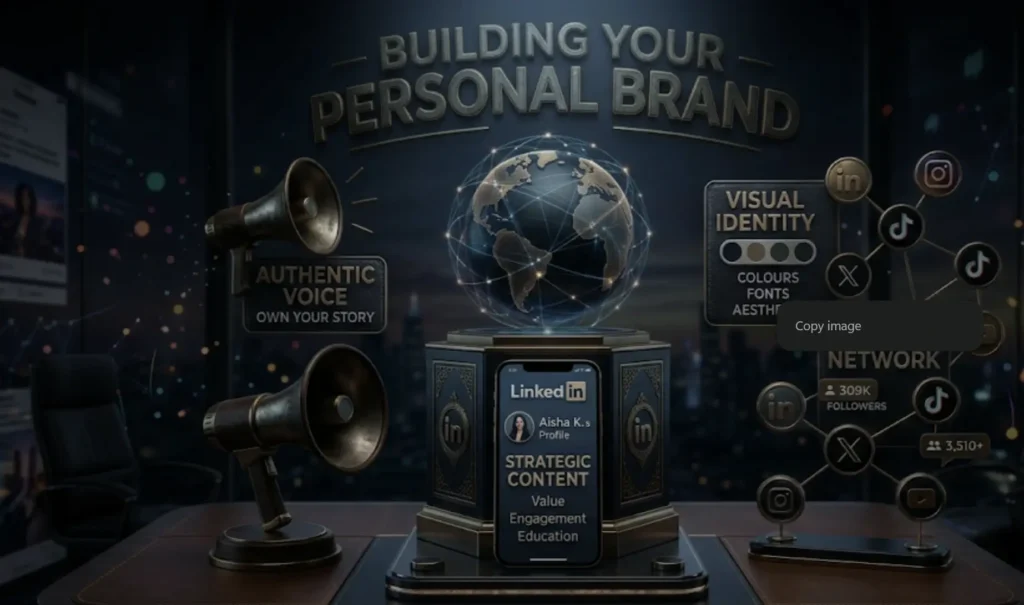
Personal Branding vs. Personal Marketing
Personal branding and personal marketing are closely connected, but they serve different purposes.
Personal branding focuses on how you are perceived. It communicates your expertise, personality, values, interests, and professional identity. Personal marketing, on the other hand, focuses more directly on promoting your skills, services, achievements, or professional offerings.
For example, a freelance graphic designer may use personal marketing to promote their design services. Their personal brand could be built around their creative approach, design philosophy, expertise, and personality.
This distinction is important when developing personal branding on social media. If every post is focused on selling something, your audience may find the content overly promotional. A stronger approach is to establish credibility and provide value first, allowing promotional content to become part of a broader and more authentic online presence.
In simple terms, personal marketing tells people what you offer, while personal branding helps them understand who you are and why they should remember you.
Categories of Content That Strengthen Personal Branding on Social Media
Content is at the heart of personal branding on social media. The content you publish gives your audience an opportunity to understand your expertise, personality, opinions, and values. Instead of focusing on one type of post, a balanced content strategy can make your personal brand more informative and engaging.
Educational Content
Educational content is one of the most effective ways to demonstrate your knowledge. You can share practical tips, simple explanations, guides, tutorials, or lessons related to your area of expertise.
For example, someone building a personal brand around digital marketing could share SEO techniques, advertising insights, content strategies, or observations about changing consumer behaviour. Providing useful information consistently can help establish credibility.
Industry Insights
Sharing relevant industry developments and your perspective on them can strengthen your professional identity. You can discuss emerging trends, important changes, interesting campaigns, or developments within your field.
This type of content can show that you are not simply creating posts but actively paying attention to your industry.
Personal Experiences
Personal branding does not have to be entirely educational. Your experiences can make your content more relatable and memorable.
You can share lessons from projects, professional challenges, mistakes, achievements, or experiences that taught you something valuable. The key is to connect your experience with something your audience can learn from.
Case Studies and Examples
Case studies allow you to demonstrate how your knowledge applies to real situations. You can analyse a campaign, explain how a strategy worked, discuss a successful brand, or break down a problem and its solution.
For professionals and freelancers, this type of content can be particularly useful because it provides evidence of how they think and approach problems.
Opinions and Perspectives
Your perspective is an important part of personal branding on social media. You do not have to agree with every popular opinion within your industry.
Thoughtful opinions and well-explained perspectives can help differentiate you from others discussing similar subjects. However, your opinions should be supported by reasonable arguments rather than being controversial simply to attract attention.
A strong content strategy combines knowledge with personality. When people consistently find your content useful and recognize your perspective, your online presence becomes easier to remember.
The Right Way to Build a Personal Brand on Social Media
Building a recognizable online presence does not happen overnight. It requires clarity, consistency, and patience.
1. Define Your Niche and Audience
Your niche could be digital marketing, fitness, fashion, finance, technology, photography, or another area where you have knowledge or genuine interest.
Then identify who you want to reach. Understanding your audience makes it easier to create content that is relevant to them.
2. Identify Your Unique Value
Ask yourself: What can I offer that others may find useful?
Your advantage could be your experience, knowledge, personality, storytelling ability, or a different perspective on familiar topics. Your personal brand should reflect something authentic rather than simply copying someone else’s strategy.
3. Choose the Right Platforms
You do not need to be active on every social media platform.
LinkedIn can be particularly useful for professional networking, while Instagram and TikTok may work well for visual and short-form content.
4. Develop a Consistent Identity
Consistency makes a personal brand easier to recognize. This includes your profile photo, bio, visual style, tone of communication, and the subjects you regularly discuss.
Your content does not have to look identical every time, but there should be a recognizable connection between your posts.
5. Share Valuable Content
Avoid making every post about yourself. Instead, focus on providing something useful to your audience.
You can share tips, lessons you have learned, industry insights, case studies, opinions, mistakes, or practical solutions. The goal is to give people a reason to follow you.
6. Show Your Personality
A personal brand should still feel personal. While professionalism is important, do not make your content so formal that it becomes impersonal.
Share your experiences, opinions, challenges, and lessons when appropriate. Authenticity can make your content more memorable.
7. Engage With Your Audience
Respond to comments, participate in relevant discussions, answer questions, and connect with people in your industry.
Social media is a two-way conversation, and genuine engagement can help turn followers into a community.
8. Stay Consistent and Measure Results
Consistency is more important than posting excessively for a short period.
At the same time, monitor your performance. Look at metrics such as engagement, reach, profile visits, and follower growth to understand what your audience responds to. Use these insights to improve your content strategy:
Personal Branding on Social Media Starts With Consistency
Consistency helps people recognize your expertise and remember what you stand for. Regularly sharing valuable content can make personal branding on social media more effective over time.
How Long Does It Take to Build a Personal Brand?
There is no fixed amount of time required to build a successful personal brand. Some people may gain visibility quickly, while others may take months or years to establish a strong reputation.
The difference often comes down to consistency, content quality, audience relevance, and the strength of the relationships they build.
When starting personal branding on social media, it is better to focus on becoming recognizable to the right audience rather than trying to become popular as quickly as possible.
A smaller audience that trusts your expertise can be more valuable than thousands of followers who have little interest in what you offer.
Think of personal branding as a long-term investment. Every useful post, meaningful conversation, professional connection, and valuable insight contributes to the reputation you build over time.
Instead of asking how quickly you can grow, ask whether the content you are publishing is helping people understand what you know and what you represent.
Common Personal Branding Mistakes to Avoid
Building a personal brand becomes easier when you know what not to do. Avoid copying another creator’s personality or content strategy simply because it works for them. Your brand should reflect your own strengths and perspective.
Other common mistakes include trying to appeal to everyone, posting inconsistently, constantly promoting yourself, ignoring comments and messages, and prioritizing followers over meaningful engagement.
Most importantly, do not expect instant results. Building trust and recognition takes time.
Why Personal Branding Requires Content Writing
Personal branding requires content writing to communicate your ideas, expertise, and personality effectively. Consistent content helps establish your unique voice, build credibility, engage your audience, and make your brand more recognizable on social media.
Frequently Asked Questions About Personal Branding on Social Media
What is personal branding on social media ?
Personal branding on social media is the process of intentionally presenting your expertise, personality, values, interests, and professional identity through your social media presence and content.
How often should I post for personal branding?
There is no universal posting frequency. The better approach is to choose a realistic schedule that allows you to consistently create valuable content without sacrificing quality.
Can students build a personal brand on social media?
Yes. Students can use personal branding on social media to showcase their interests, projects, skills, knowledge, achievements, and professional development. Starting early can help them develop a recognizable online presence before entering the workforce.
Does personal branding require a large following?
No. A large following is not necessary to build a strong personal brand. Reaching the right audience and developing trust can be more valuable than simply accumulating followers.
What should I post for personal branding on social media?
You can share educational content, industry insights, personal experiences, case studies, practical tips, opinions, and relevant professional information. The best content should provide value while reflecting your expertise and personality.
Is personal branding only useful for entrepreneurs?
No. Personal branding can benefit students, employees, freelancers, creators, job seekers, professionals, and entrepreneurs. Anyone who wants to establish a recognizable professional identity online can benefit from it.
How can I make my personal brand more authentic?
Focus on communicating your genuine knowledge, experiences, opinions, and values rather than copying another person’s personality or content strategy. Authenticity becomes easier when your online presence reflects who you actually are.
Can personal branding help with career opportunities?
Yes. A strong online presence can help potential employers, clients, collaborators, or professional connections understand your expertise and experience. It can also give you an opportunity to demonstrate knowledge beyond what appears on a traditional résumé.
Conclusion
Personal branding on social media has become an essential part of building a strong digital identity. Through personal branding on social media, individuals can showcase their expertise, communicate their values, and connect with the right audience. A consistent approach to personal branding on social media helps establish credibility and recognition over time.
For professionals, personal branding on social media can open doors to new opportunities, partnerships, and career growth. Entrepreneurs can use personal branding on social media to build trust and create stronger relationships with potential customers. Similarly, students and creators can benefit from personal branding on social media by developing a recognizable online presence.
The effectiveness of personal branding on social media depends on authenticity, consistency, and valuable content. Successful personal branding is not simply about posting frequently; it is about creating a meaningful identity that people remember. With the right strategy, personal branding on social media can turn an ordinary profile into a powerful professional asset.
Investing in social media today can help you remain visible and relevant tomorrow. Ultimately, personal branding on social media is about communicating who you are, what you offer, and why people should trust you.
By approaching personal branding strategically, anyone can strengthen their reputation and build meaningful connections. In the long run, personal branding on social media can become one of the most valuable tools for personal and professional growth.